Sharing ideas on Education, Leadership and Life


Wednesday, January 7, 2015

Growing and Learning

picture: pinterest.com

This will be the seventh post as part of the TeachThought blog challenge. I want to take a moment and just thank those at TeachThought for putting together these amazing prompts. it has been a truly great learning experience and I am happy that I became connected to this amazing group.

I am also amazed how so many ideas, and topics come back to similar themes. It seems  like I am repeating myself by when reinvent the wheel or why fix it if its not broken.

When I think of professional development I would rather call it professionally learning. So when I think of professional learning a few common ideas ( which I have mentioned a number of times already) come to mind

Those ideas are

  • Lifelong learning 
  • Collaborating
  • Social media 
  • Reading 
Below are two blog posts about these topics and I think it was worthy to re post them here as it relates to this topic. 


 Reposted from Archives:

The name of my blog is Views of a Lifelong Learner. Well what is it to be lifelong learner? Today I came across the following article.

"Six Ways to Be a Lifelong Learner " Here are the six points  the author makes


  • Read daily.
  • Seek out experts
  • Make connections
  • Turn off the TV
  • Find the time. 
  • Invest in yourself
I highly recommend reading the entire article as the author expands on each of the six points. 
I will like to add my own and in some cases agree with the ones listed above with my own commentary. 


  1. YES! READ READ and READ One needs to be current on the latest trend in what ever field they are in and they need to be gaining more knowledge all the time. Imagine if the skill set you are using now was the same one you used in high  school. 
  2. Develop a PLN - This is similar to the second and third points above. No one person can know it all and they need to rely on others for help. Why reinvent the wheel when you don't have to. It says in "Ethics of Our Fathers"; "who is truly wise, one who is willing to learn from anyone 
  3. Related to number two is that we need to try new things and take risks. We don't know everything and the only way we can learn is by trial and error. 
  4. Be willing to adapt to change. To learn means to grow and change and we need to willing to embrace that. 
  5. Be a lifelong learner is journey it never ends. It is the ultimate marathon. So you need to ready for the long haul. 

Originally written in Jan 2012

This past Wednesday night's #JEDCHAT was devoted to takeaways from the recent #NAJDS Conference. 
One of main ideas shared was the importance of meeting people sharing ideas and seeing what is done in other schools and just networking with other educators. 
While nothing can replace face to face interaction but i believe the sharing of ideas, learning from others and just developing a Network or in other words a PLN could be developed through ones interactions and use of Twitter. 
Recently Lyn Hilt, an amazing Educational leader and a personal inspiration to me wrote the following blog post;Battling skepticism.At the end she asked the following question;"So what I’m looking for in the comments section below are ways that administrators who are new to social media and professional learning networks can get started. Help their fears subside… help them battle the skepticism and preconceived notions they may have about the tools and the connections made.

Here is an part of the comment I left on the blog; 
"Lyn,
Another great post!
Yes I am fairly new to Twitter. This summer will be two years. I never imagined myself on twitter let alone blogging and starting a Chat for Jewish educators. I think people need to “dip their toe in the water” and try it. Take it slow and at first just lurk follow the #edchat and #cpchat streams using TweetDeck or Hootsuite. Follow some blogs and then once the water is right jump in.
One thing that I have personally found is that Twitter is a very safe environment and people want to hear what you have to say. Otherwise how do explain an Orthodox Rabbi from Memphis TN. with over 2200 followers.
My only regret is that I have only met a handful of my amazing PLN in person.
Lyn, Thanks again for sharing and for being an inspiration to me."
My point is that we all want to connect and learn form others and that is often what is the highlight of any conference. So when the question is how can we keep that feeling we got at the conference going or how can we build on it and sustain it through out the year? My answer is develop a PLN, join twitter follow #edchat, #cpchat and of course #jedchat. Twitter is that 24/7 365 Conference.
Akevy 

Tuesday, January 6, 2015

WHAT SKILLS ARE NEEDED

picture: www.wildapricot.com

Today's prompt is on what advice would I give to new teachers?

So recently there was a Facebook conversation on the JEDLAB group page. Here was the question

A brand new teacher, fresh out of grad school, wants a good, practical, no nonsense, less abstract, more concrete, list of strategies book (or books) that will help her be a more effective teacher. (Cant get more loaded then that!) Suggestions? Tikvah Wiener Matt Williams Jon Mitzmacher Eliezer JonesPearl Mattenson Maccabee Avishur Shira Leibowitz Shira HochheimerNancy Levine Siegel Naomi Weiss Akevy Greenblatt Aaron Ross Aliza Chanales and the rest of JEDlab

There was such a lively discussion that a Google Doc was created to compile all the different answers. 

As many have mentioned before putting this into a short post with one or two ideas and skills is very hard. 

However  I would have to say two come to mind as being crucial. 

The first is  being a lifelong learner. Teachers need to be learning and growing all the time and they need to model this behavior for their students. The analogy I like the best is that some would not go to a doctor who attended medical school 20 years ago and is not current with he latest trends in the medical profession. Why would we and should we expect anything less from our educators and they  to need to be update on the latest trends in education. 

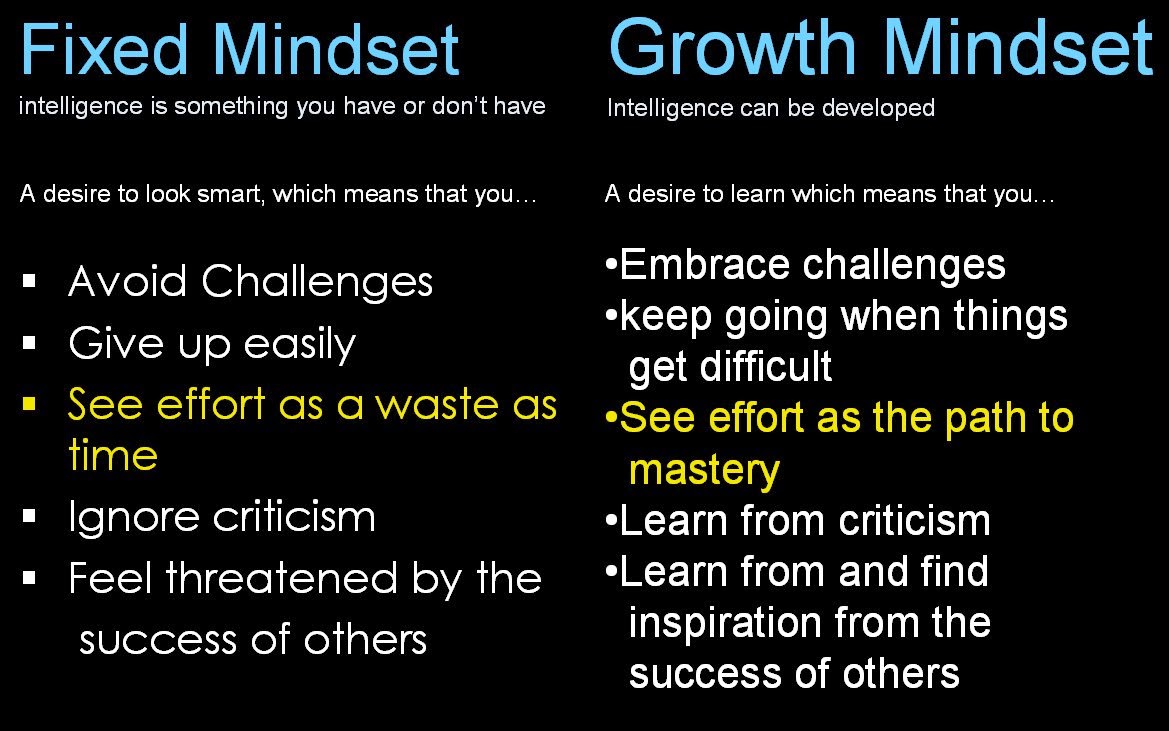
The second is developing a growth mindset. That to me probably should have been first. A growth mind set allows a person to grow and not be stuck where they are. It encourages risk taking, and being open to feedback and constructive criticism. So a growth mindset  includes many other important skills. 


picture : 
msaprilshowers.com

Monday, January 5, 2015

INSTILLING MOTIVATION


Picture from ASCD


Yesterdays prompt was about our own growth and motivation and today the topic is how can we instill that in our students. Well obviously if we are positive and motivated then that should come across to our students. One of the most powerful tools we have is the ability to be role models and without even saying a word we could effect the lives of our students. Honestly powerful but scary.


Below is a post I wrote in September about motivation and I am reposting here for this blog challenge.


I think we could all agree that today we want our students to be motivated and engaged in the learning process. Daniel Pink says "With engagement you're doing something because you truly want to do it, because you see the virtues of doing it. However Pink contrasts that with complaint behavior when do something because someone told to do it.


Many classroom by default are places that we see more complaint behavior than engaged behavior and in reality we need to shift this so that students are engaged and are given a sense of freedom.


Pink says it best; We need leaders, both in organizations and in schools, who create an atmosphere in which people have a sufficient degree of freedom; can move toward mastery on something that matters;and know why they're do something, not just how to do it.........As parents, as teachers, as entire organization, our instinct it toward greater control. We think control is going to make something better. But people only have two reactions to control: They comply or defy. We don't want defiant kids but we also don't want compliant kids. We want kids who are engaged. If you truly want to engage kids, you have to pull back on the control, and create conditions in which they can tap into their own inner motivations."


To have engaged students we need to give up on the control and allow the natural motivation to shine. All students are motivated the only question is what is their level of motivation. By giving up control and allowing the motivation to come through we will end up with more engaged students.


Jackson and Zmuda in their article "4 Keys to Student Engagement" also make the the distinction between Complaint and Engaged. They point out the following:

"Real engagements not compliance. We can't pine for engaged learners when our policies and practices tend to focus on producing compliant learners. If we want to grow capacity in our students;unearth student talents, dreams, and aspirations; and instill perseverance through a focus on doing hard work, learning from mistakes and revising one's work,we need to design classroom practices around securing real engagement.


To sort of wrap things up Cossett and Gilmore in their article "10 Standards for Motivation " give us a top 10 list:


The need for Active Learning
Lessons incorporate student autonomy
Learning is relevant
Frequent opportunities for collaboration
Appropriate use of technology
Multiple learning methods
A balance of challenge and success the create independence.
Differentiate
Feedback and authentic assessment
Inquiry that promotes a sense of curiosity and desire to learn


To sum up : Motivation + Autonomy= Engagement and Compliance and Control reduce motivation and therefore limit true engagement.

Sunday, January 4, 2015

Developing and Growing

So here is today's prompt/ question from TeachThought

"What is one area of my learning and teaching I want to develop this year?" 

So I am no longer teacher but as a professed lifelong learner I am always learning something. 

My passion is in meeting students needs given our diverse student population and using technology, creativity and the arts to help meet those needs. So I am always looking for good material about those subjects. 

I also have a passion towards leadership and like to read books about on that subject as well 

Just to give a sense of what I am talking about here are two pictures from my kindle on my iPad 


These were taken in August I have updated it a bit since then 

On a more personal note I would like to develop my writing skills so that I can make this dream of publishing a book a reality and work on my marketing skills and web design so that my  consulting business can take off in a real way. 


Saturday, January 3, 2015

LOOKING UP - STAYING POSITIVE

picture: www.quotepix.com

Today's Prompt for the TeachThought blog challenge is areas for improvement or growth.

For me the one area that I need to work on is staying positive and looking up and not getting down about my current situation and not dragging my friends down with me.

I want to publicly thank Amanda Countryman Dykes for her #365suucess challenge, which is "forcing" me in a good way to reflect on the success and not focus on all the challenges.

For many this coming week brings a new focus and new  excitement and a "NEW YEAR" with resolutions and commitments.

For Jews this is a "second new year", since for us the time of introspection and resolutions comes with the High Holidays.
I want to share with you a post I wrote recently prior to Yom Kippur the holiest day on Jewish Calendar.

It has been a while since I blogged. One reason is that while I have had a lot on my mind and a lot to blog about I wasn't able to put into words. I sit here hours before the holiest day on the Jewish Calendar Yom Kippur, The day of Atonement.
There is a lot I could say and a lot I can reflect on over the pass year. During this past year my family and I have faced a number of challenges and I know that each challenge is a test and that G-D has given us the tools to pass each challenge and test. .
However as we learn from the laws regarding Yom Kippur and repentance we have to make the effort and take the steps needed. Therefore not only to I sit here and reflect but I respond as well.
I respond with a Thank You first and foremost to G-D for his daily blessings and for all that I have and secondly to my family and friends. I have a loving family, a loving wife who has stood by me during each challenge two beautiful girls who never cease to amaze me on how caring and dedicated they are. I have an  amazing extended family and friends who at times believed more in me than I did.
As I look towards the coming year and hope and pray for a year of health, peace, happiness, and prosperity I know I need to make and effort as well. While I find myself in uncharted waters right  now I know that I will be given the tools and ability to navigate these new waters. To that end I have begun a new venture into consulting with the formation of  Star Educational Consulting

I hope and pray daily that in the coming year I will be a better person, husband, father, and friend.
May this new year be one of peace ,health, happiness and prosperity to all

Akevy

Friday, January 2, 2015

WE ARE ALL UNIQUE

picture: www.mybehaviorresource.com

Today's prompt for the TeachThought blog challenge  is 'What is unique about teaching style?'

Honestly for me this is a hard one.  I am not sure I would consider myself unique or that I do anything special.

However I will share with you certain qualities that I have that I think are important for all educators.

By no means is this a list of all my qualities ( LOL) and by no means are these the only qualities


  •  A Lifelong Learner 
  • Having a growth mindset 
  • Willing to embrace and accept change 
  • A people person 
  • Someone who smiles
  • Being a team player and willing to collaborate 
  • Kind and cares about others 
  • Trustworthy
There are other qualities that I have that are honestly both positive and can be negative as well 

  • Seeing the big picture - Taking the "balcony view" . While this is important at times some of the little details get over looked and people sometimes need you to focus on the details. 
  • Wearing my emotions on my sleeve- I tend to be very passionate and sometimes emotional about things I care about. While a great quality at times you need to be more reserve and keep things a bit closer to the chest. I probably wouldn't make a very good poker player. 
However as my friend Angela Maiers  "YOU MATTER" and she is so right we all matter. We have unique qualities both positive and some we need to work on and that is what makes us unique.

We need to remember that about our students as well. "ONE SIZE DOESN'T FIT ALL". Each student brings his or her unique qualities to the classroom and each adds a certain dimension to the class. As I have often told my own students you can't have a team of all "insert your favorite sports star" 

So in reality we are ALL UNIQUE and THAT'S A GOOD THING! 

Thursday, January 1, 2015

Student Involvement

picture: pintrest.com


Happy New Year!

I mentioned yesterday that I would be announcing a new challenge. At the time I wasn't sure what to do. I thought about just doing the 30 day challenge again. Then I saw a post from TeachThought about a blog challenge they are doing.

"REFLECT AND RENEW IN 2015 - The January Blog Challenge!"


So I got my answer I will be participating in this challenge. Each day they have a different prompt for the blog post and you can follow the posts on twitter using the hashtag #reflectiveteacher. 

Today's prompt is: What are my beliefs about how students learn best?

That's a easy one. 

Students need to be involved and engaged in the learning process. The famous quote of Benjamin Franklin comes to mind; "Tell me and I forget, teach me and I may remember, involve me and I learn.”

Students need to be involved and be empowered to be part of the learning process. There is a difference between teaching and learning. A Teacher may teach but that is no guarantee that students will learn. Teaching by nature is teacher centered where as learning is student centered and requires the involvement of the students. 

How can students learn if they are just lectured to and spoken to all day? 

What meaning does the 'Teaching" have if the students aren't part of the process?

How can learning take place or be meaningful without student involvement?

The answer is obvious learning only take place with the students being involved and engaged in the process and requires students to buy into it and own it. 

This is all very nice but how do we accomplish this? 

I have often said one sizes doesn't fit all and there are a number of different ways this can be accomplished in my opinion. Here are some:

  • Technology is a great way to make the learning real and engaging. Learning about the moon of the solar system, you can now  virtually explore the moon. That's just one example 
  • Using problem or project based learning offers very real and hands on experiential learning to take place
  • Asking questions. Teachers need to allow the students to think and ask question and not just give them the answers. 
  • Talk less. I read a book in which the author suggested that teachers need to talk less and allow the students to play a greater role in both the teaching and learning process. 
  • Learn together.  The same author suggested that what if a teacher asked a question that the teacher didn't know the answer to and the class together with the teacher had to explore, discover, and find the answer together. 
I look forward to hearing your thoughts and comments 
Happy New Year!